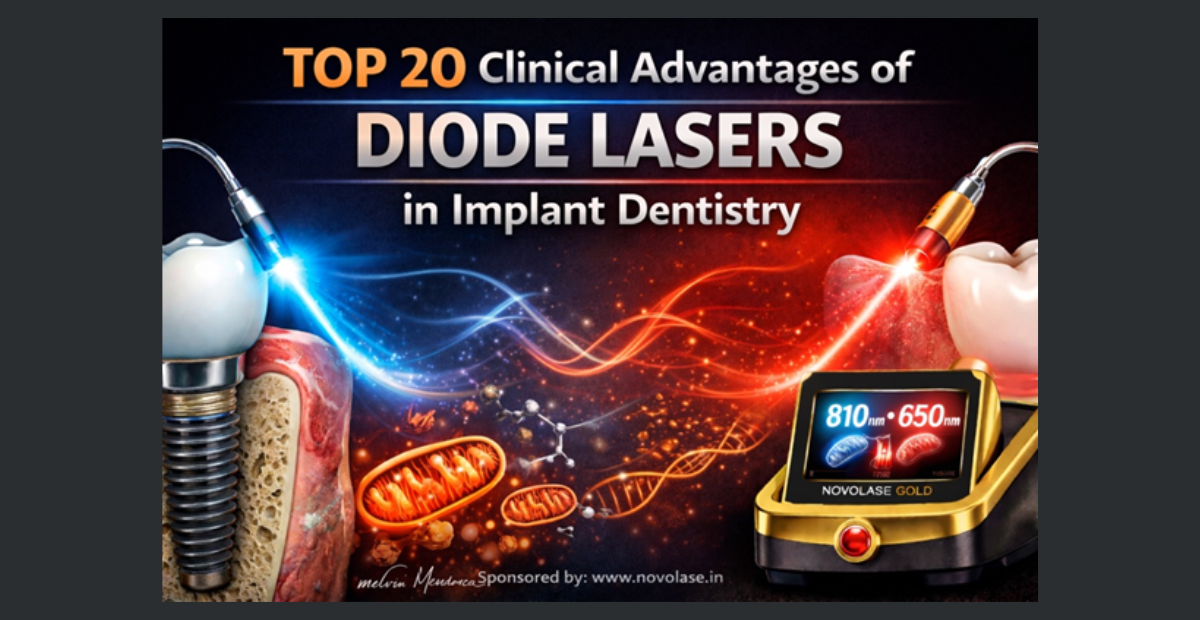
Top 20 Clinical Advantages of Diode Lasers in Implant Dentistry | Scientific Review
 World Impant Expo Admin
Top 20 Clinical Advantages of Diode Lasers in Implant Dentistry
A Scientific Review of Laser-Assisted Implantology
Author:
Dr. Melvin Mendonca, DBA
DentistChannel.online – Global Dental Media and Education Platform
Scientific Contributors Referenced:
Romanos GE, Aoki A, Parker S, Gutknecht N, Karu TI, Schwarz F, Sgolastra F, Kreisler M, Walsh LJ, Coluzzi DJ and others.
Sponsored by:
🌐 www.Novolase.in
Abstract
Laser technology has become an important adjunct in modern implant dentistry due to its ability to enhance surgical precision, reduce bacterial contamination, and accelerate tissue healing. Among available dental lasers, diode lasers (630–980 nm) are widely used because of their compact design, efficient soft-tissue interaction, and photobiomodulation capabilities. Research has demonstrated that diode lasers provide several advantages including improved hemostasis, reduced postoperative discomfort, enhanced wound healing, and adjunctive benefits in peri-implant disease management.
Recent developments in dual-wavelength diode lasers combining surgical wavelengths (~810 nm) and photobiomodulation wavelengths (~650–660 nm) have further expanded the clinical applications of laser-assisted implantology. These wavelengths allow clinicians to perform soft-tissue surgical procedures while simultaneously stimulating biological healing responses through mitochondrial activation and enhanced cellular metabolism.
This review highlights twenty clinically relevant advantages of diode laser technology in implant dentistry, supported by contemporary research and clinical observations.
Introduction
Dental implants are considered the gold standard for tooth replacement. However, implant therapy still faces biological challenges including soft-tissue inflammation, bacterial contamination, delayed healing, and peri-implant diseases.
Over the past two decades, lasers have been increasingly integrated into dental implant procedures. According to Romanos and colleagues, laser-assisted implant therapy offers advantages in soft-tissue management, bacterial reduction, and improved surgical control.
Diode lasers are particularly attractive because they:
- operate within biologically effective wavelengths (630–980 nm)
- interact strongly with hemoglobin and melanin
- allow minimally invasive soft-tissue surgery
These characteristics make diode lasers highly suitable for implant uncovering, peri-implant therapy, and photobiomodulation-assisted healing.
Mechanism of Diode Laser Action
Laser-tissue interaction is determined primarily by wavelength and chromophore absorption. The main chromophores involved in diode laser dentistry include hemoglobin, melanin, and mitochondrial enzymes.
Two primary clinical mechanisms are involved:
1. Surgical Laser Interaction
Near-infrared wavelengths (808–980 nm) are absorbed by hemoglobin and melanin, enabling:
- precise soft-tissue incision
- coagulation
- bacterial reduction
2. Photobiomodulation (PBM)
Red wavelengths (~650–660 nm) stimulate mitochondrial enzymes such as cytochrome-c oxidase, increasing ATP production and cellular metabolism. This leads to improved healing and tissue regeneration.
Top 20 Clinical Advantages of Diode Lasers in Implant Dentistry
1. Bloodless Surgical Field
Diode lasers provide excellent hemostasis, improving surgical visibility and control during implant procedures.
2. Precise Soft-Tissue Incisions
Laser energy allows micron-level precision compared with conventional scalpel surgery.
3. Reduced Postoperative Pain
Photobiomodulation reduces nociceptor activation and inflammatory mediators, decreasing postoperative discomfort.
4. Faster Wound Healing
Laser therapy stimulates fibroblast proliferation and collagen formation.
5. Reduced Postoperative Swelling
Laser energy seals lymphatic vessels and minimizes inflammatory edema.
6. Improved Patient Comfort
Laser procedures reduce mechanical trauma, vibration, and noise during surgery.
7. Reduced Need for Sutures
Laser incisions often coagulate tissue margins, eliminating or reducing suturing requirements.
8. Bacterial Reduction
Laser irradiation significantly reduces bacterial load around surgical sites.
Studies demonstrate that diode lasers reduce pathogenic bacteria associated with peri-implant diseases.
9. Implant Surface Decontamination
Lasers assist in detoxifying contaminated implant surfaces.
10. Enhanced Osseointegration
Photobiomodulation can stimulate bone remodeling and implant stability.
11. Improved Implant Stability
Clinical trials have shown improved implant stability measurements when PBM is applied around implants.
12. Reduced Risk of Infection
Laser disinfection reduces microbial colonization during implant procedures.
13. Better Soft-Tissue Aesthetics
Laser sculpting provides superior gingival contouring and tissue aesthetics.
14. Minimally Invasive Implant Uncovering
Laser-assisted second-stage surgery can reduce surgical trauma.
15. Adjunctive Treatment for Peri-Implant Mucositis
Studies show diode lasers may improve clinical outcomes when combined with mechanical debridement.
16. Supportive Therapy in Peri-Implantitis
Laser therapy can reduce bacterial biofilm and inflammatory mediators around implants.
17. Enhanced Cellular Activity
Laser irradiation increases cellular attachment and differentiation around implant surfaces.
18. Photobiomodulation for Bone Healing
PBM has been shown to accelerate bone repair and regeneration around implants.
19. Reduced Analgesic Consumption
Clinical trials suggest patients receiving laser PBM require fewer pain medications after implant surgery.
20. Improved Long-Term Implant Maintenance
Laser therapy can be integrated into maintenance protocols for peri-implant health.
Role of Dual-Wavelength Lasers in Implant Dentistry
Modern laser platforms increasingly integrate dual wavelengths to combine surgical capability with photobiomodulation.
Typical examples include:
- 810 nm wavelength – soft-tissue surgery and bacterial control
- 650 nm wavelength – photobiomodulation and tissue regeneration
This combination enables clinicians to address both mechanical surgical requirements and biological healing processes during implant treatment.
Limitations and Clinical Considerations
While diode lasers offer numerous advantages, clinicians should consider:
- appropriate power settings
- correct wavelength selection
- clinician training and safety protocols
Laser therapy should be considered an adjunct to conventional treatment rather than a replacement for established surgical protocols.
Future Perspectives in Laser Implantology
Emerging innovations include:
- AI-guided laser surgery
- laser-activated implant surfaces
- integrated photobiomodulation protocols
- dual-wavelength surgical platforms
These developments will likely further expand the role of lasers in implant dentistry.
Conclusion
Diode lasers have transformed implant dentistry by providing clinicians with tools that improve surgical precision, enhance healing, and reduce patient discomfort.
The integration of surgical wavelengths with photobiomodulation wavelengths has created a new paradigm in laser-assisted implant therapy.
By combining minimally invasive surgery with biological stimulation, diode lasers have the potential to improve both clinical outcomes and patient experience in implant dentistry.
Sponsored Technology Highlight
Modern dual-wavelength systems such as Novolase Gold integrate the scientific principles discussed in this review into a single platform.
Powered by Combo Coherence™ technology (810 nm + 650 nm, 10.3W), the system enables clinicians to perform:
- laser-assisted implant surgery
- peri-implant therapy
- photobiomodulation healing protocols
- minimally invasive soft-tissue procedures
Manufactured under international standards including ISO, CE, WHO-GMP, RoHS, and ISO 9001, Novolase Gold represents a new generation of laser technology in dentistry.
More information:
Key Scientific References
Romanos GE – Laser applications in implant dentistry
Aoki A – Lasers in periodontal therapy
Parker S – Laser-tissue interaction in dentistry
Karu TI – Photobiomodulation mechanisms
Schwarz F – Peri-implantitis treatment research
Sgolastra F – Systematic reviews on lasers in peri-implant diseases
Walsh LJ – Laser phototherapy in dentistry
Kreisler M – Laser-assisted implant surgery studies