High Insertion Torque in Dental Implants: Hidden Risks, Bone Loss & Titanium Particle Release Explained
 World Impant Expo Admin
The Hidden Risk Behind High Torque in Dental Implants: Are We Damaging Bone Without Realizing It?
Author
Dr. Melvin Mendonca,DBA
Founder & CEO – Dentist Channel Online
CME Provider – State Chamber of Dentists of Rhineland-Palatinate, Germany Global Healthcare Journalist – DJV (German Journalists Association)
In modern implant dentistry, there’s a moment every clinician recognizes—the “click”. That satisfying feeling when the implant feels locked in place. It signals primary stability, confidence, and control.
But here’s the uncomfortable question:
What if that extra turn is not improving stability—but silently damaging the bone?
Understanding the Reality Behind Insertion Torque
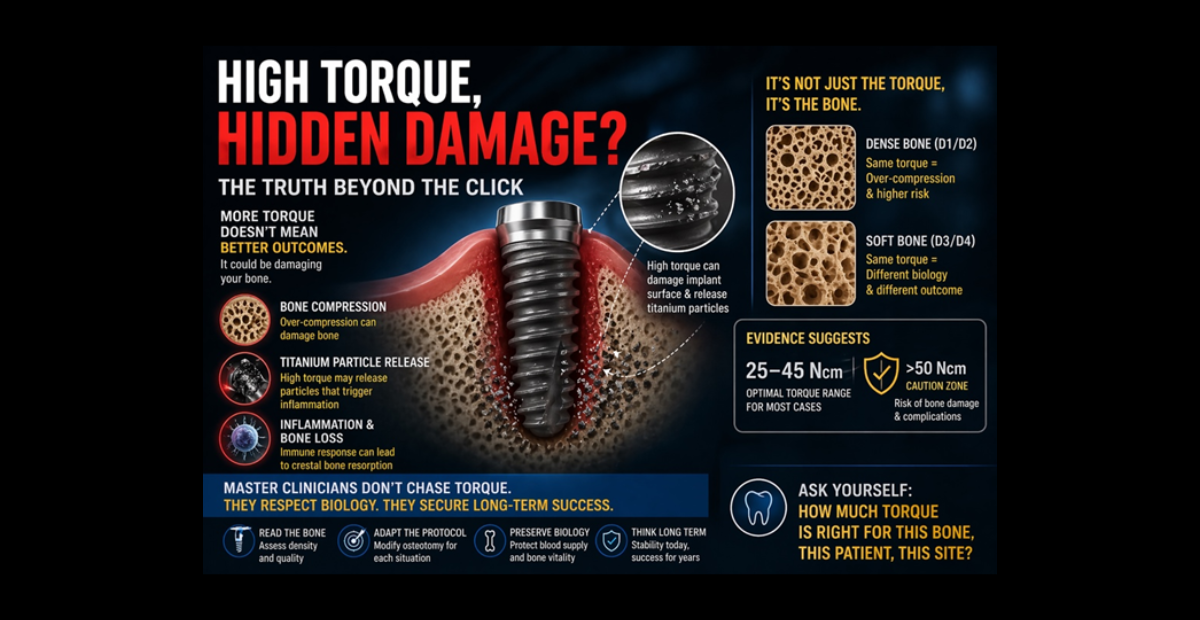
Insertion torque (Ncm) is widely used to measure primary stability. However, growing scientific evidence shows:
- Moderate torque improves stability
- Excessive torque increases bone stress
- Torque above ~50 Ncm may compromise biology
Torque is not just a mechanical value—it is a biological response.
What Happens When Torque Is Too High?
1. Bone Compression & Microdamage
Excessive torque causes:
- Over-compression of peri-implant bone
- Increased strain beyond physiological limits
- Microfractures and delayed healing

2. Osteocyte Death & Ischemia
High compression may:
- Reduce blood supply
- Trigger osteocyte apoptosis
- Expand zones of bone injury
Known as compression-induced bone necrosis


3. Titanium Particle Release – The New Concern
Recent research (2024–2025) reveals:
- High torque can damage implant surface microstructure
- Titanium particles are released at the bone crest
- These particles trigger:
- Macrophage activation
- Inflammatory cascade
- Immune-mediated bone resorption
Bone loss may occur not only from pressure—but from immune response.


Why Torque Alone Is Misleading
The same torque behaves differently depending on bone density:
|
Bone Type |
Effect of 50 Ncm |
|
Dense (D1) |
Over-compression, necrosis risk |
|
Soft (D4) |
Achieved via under-preparation, different biology |
Same number ≠ same biology
What Is the Ideal Torque Range?
Evidence suggests:
- 25–45 Ncm → Optimal in most cases
- >50 Ncm → Risk zone
- <20 Ncm → Acceptable in selected protocols
There is no universal torque—only context-driven torque
Clinical Strategy: Adapt to the Bone
Dense Bone (D1/D2)
- Use countersinking
- Reduce compression
- Avoid excessive torque
Soft Bone (D3/D4)
- Under-prepare osteotomy
- Improve primary stability carefully
The Advanced Concept: Passive Implant Placement
Most implants today rely on aggressive threads and high torque.
But an emerging concept is:
Passive Implant Philosophy
Instead of forcing the implant into bone:
The implant is gently guided into a precisely prepared osteotomy
Why Passive Implants Are Safer
Passive implants:
- Reduce stress on bone
- Preserve blood supply
- Minimize osteocyte damage
- Reduce titanium particle release
- Support long-term crestal stability
They work with biology, not against it
Examples of Passive / Low-Aggression Implant Systems
- Dentsply Sirona – Ankylos Implant System
- Argon Dental – K3 Pro Sure Implants
- Argon Dental – K3 Pro Sure Short Implants
- Bicon – Bicon Short Implants
These systems emphasize:
- Controlled insertion
- Reduced thread aggressiveness
- Bone-friendly integration
The Real Truth
A torque wrench gives you a number.
But that number alone is incomplete.
Great implantology is not about chasing torque—it’s about respecting biology.
Final Thought
Next time you place an implant, don’t ask:
❌ “How much torque did I get?”
Ask:
✅ “Is this the right torque for this bone, this patient, this site?”
The future of implant dentistry is shifting:
➡️ From force → to biology
➡️ From compression → to preservation
➡️ From aggressive → to passive systems
Explore passive implant concepts for long-term success and predictable outcomes
Because:
Osseointegration is not forced—it is earned.
Scientific References & Research Papers
- Impact of High Insertion Torque on Implant Surface Integrity (2025)
https://onlinelibrary.wiley.com/doi/10.1111/cid.70030 - Titanium Particle Release and Biological Effects Around Implants (2024)
https://pmc.ncbi.nlm.nih.gov/articles/PMC11729244/ - Compression Necrosis in Implant Dentistry (2024 Review)
https://pmc.ncbi.nlm.nih.gov/articles/PMC10926919/ - Insertion Torque vs Implant Stability Study
https://pmc.ncbi.nlm.nih.gov/articles/PMC5976959/ - Optimal Torque and Osseointegration (2025 Scoping Review)
https://www.mdpi.com/1648-9144/61/7/1187 - Low Torque Implants and Clinical Outcomes
https://pmc.ncbi.nlm.nih.gov/articles/PMC12744506/ - Bone Density & Implant Stability Research
https://www.mdpi.com/2304-6767/7/1/25
Sponsored Message
This article is sponsored by Argon Dental, Germany
🌐 www.argon-dental.de