Best Implant Design for Immediate Placement | Evidence-Based Guide
 World Impant Expo Admin
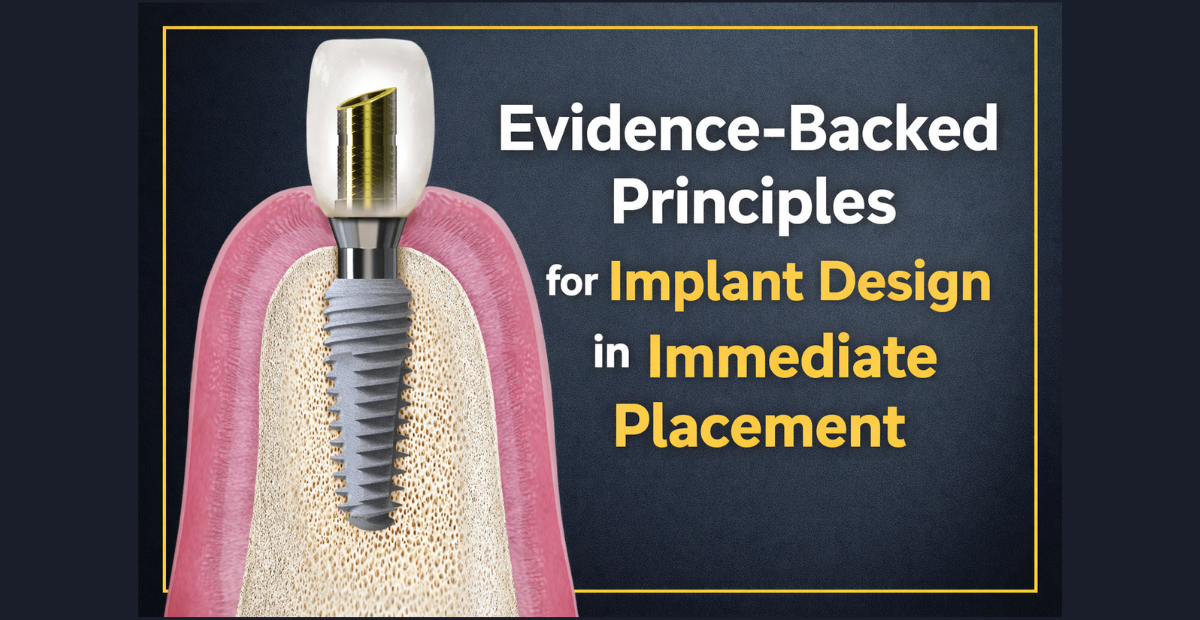
Evidence-Backed Principles for Implant Design in Immediate Placement
1️⃣ Primary Stability Determines Success in Immediate Placement
A literature review explains that implant mechanical stability and design (macrogeometry + surface) are central to achieving early stability needed for successful osseointegration and immediate protocols. Primary stability is the foundation for immediate or early loading. PMC
Read: Huang YC, et al. Review on factors influencing implant placement stability and implant design. PMC (2023).
2️⃣ Tapered Implants Provide Better Primary Stability
Clinical studies consistently show that tapered implants achieve higher stability (insertion torque / ISQ) compared with straight-walled cylindrical implants—an important predictor for immediate protocols. PMC+1
- In immediate placements, tapered implants had higher ISQ values vs cylindrical implants in fresh and delayed placements. PMC
- Another comparative clinical review found tapered implants had better primary stability measured by ISQ and insertion torque. PMC
Read: Pal K., et al. Evaluation of immediate and delayed placement primary stability (PMC).
3️⃣ Thread Geometry (Depth / Design) Enhances Initial Stability
Thread design isn’t cosmetic—thread depth and geometry influence how well the implant engages bone, particularly in soft or compromised sites.
A recent in vitro study showed that increasing thread depth improved primary stability (ISQ and insertion torque) in softer bone models. MDPI
Read: Cucinelli C., et al. Effects of thread depth on primary stability, MDPI (2024).
4️⃣ Apical Engagement Is Critical for Immediate Placement
For implants placed in extraction sockets, primary stability must come from remaining native bone, especially apically. A recent study highlights that 3–5 mm apical anchorage beyond the socket is commonly used to achieve this and emphasizes that implant design must consider functional surface area available apically. ScienceDirect
Read: Lebon A., Evaluation of apical portion of implant designs for functional anchorage (2025).
5️⃣ Implant Design Impacts Bone and Soft Tissue Outcomes
Clinical cohort research of a conical connection implant with variable threads and platform shifting showed favorable results over 3 years—including stable marginal bone levels and healthy peri-implant soft tissues even under immediate loading protocols. ResearchGate
Read: Prospective cohort study on immediate loading with a conical connection implant. ResearchGate article (2025).
6️⃣ Immediate Placement Delivers High Survival Rates
Systematic clinical data reveal that immediate implant placement (IIP) results in high implant survival (>90 %) in both intact and non-intact sockets over medium-term follow-up—emphasizing that immediate protocols can be predictable with proper planning and execution. MDPI
Read: Ickroth A., Systematic review: outcomes of intact vs non-intact sockets for IIP (2025).
7️⃣ Stability Assessment Tools (ISQ / RFA) Are Valid
Tools like Resonance Frequency Analysis (RFA) that measure ISQ have a strong scientific basis and are widely used to assess implant stability at placement and during healing. Higher ISQ values correlate with better stability and decision-making for loading protocols. Wikipedia
Read: Wikipedia entry on Resonance Frequency Analysis (technical overview).
What This Means in Practice
When selecting an implant for immediate placement, strong evidence suggests you should prioritize systems that include:
✔ Tapered body geometry – improves primary stability and anchorage
✔ Aggressive/progressive thread design – engages bone efficiently
✔ Apical engagement strategy – captures native bone beyond socket
✔ Internal connection & stable prosthetic platform – reduces micro-movement and supports biological sealing
✔ Clinical evidence of high survival and stable bone outcomes under immediate protocols
This evidence does not imply any implant eliminates all biological risks (like peri-implant disease). Long-term outcomes still depend on case selection, surgical technique, prosthetic planning, and maintenance.
Recommended Implant Solution for Immediate Protocols
If you’re considering an implant system for your clinic that aligns with modern design principles and clinical evidence, one option worth exploring is:
Argon K3 Pro Rapid Series — a system engineered for strong primary stability, reliable macrogeometry, and prosthetic flexibility.
Learn more at: https://argon-dental.de/implantate_rapid/