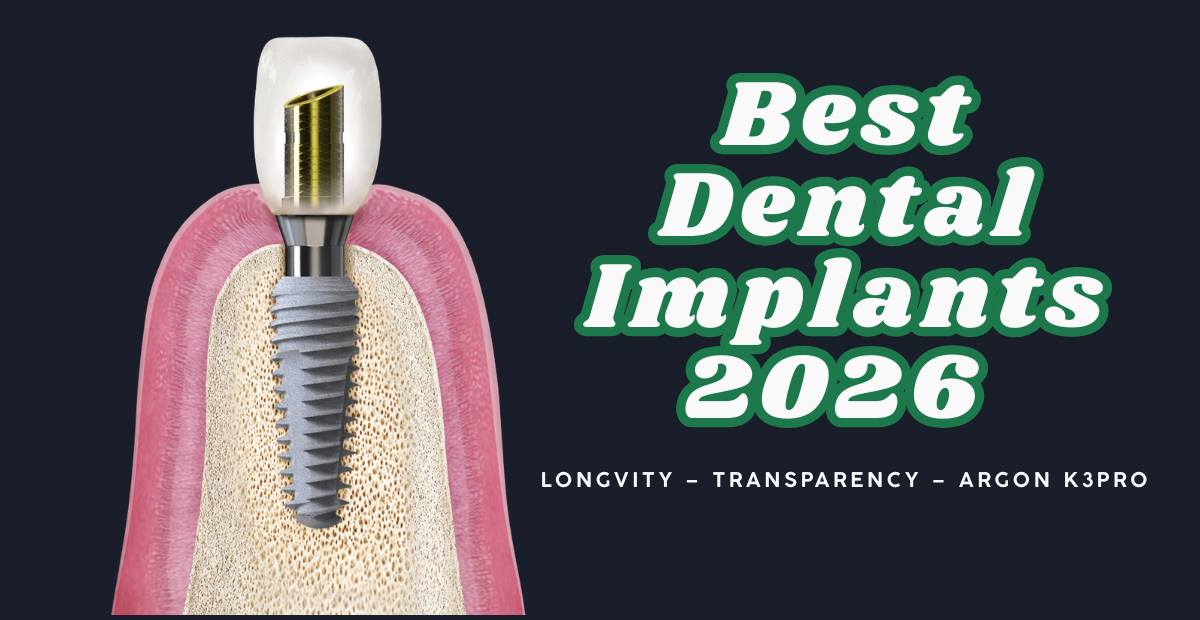
Best Dental Implants 2026: Long-Term Survival, Transparency & Argon K3Pro
 World Impant Expo Admin
Top Dental Implant Systems of 2026: Transparency, Longevity, and the Future of Implant Dentistry
Editorial analysis for clinicians, dental businesses, and patients
The Implant Market After 20 Years of Growth
Over the last two decades, dental implantology has experienced extraordinary global growth. What was once considered an advanced treatment is now a routine solution for replacing missing teeth. Millions of implants are placed every year worldwide, and thousands of implant brands have entered the market.
However, 2026 represents a turning point in implant dentistry.
For the first time, clinicians and patients are beginning to see the true long-term performance of implant systems placed 10–20 years ago. This long observation period reveals which implant designs truly deliver predictable biological and prosthetic results—and which systems require continuous repairs, maintenance, or replacement.
Today, many experienced implantologists openly acknowledge a reality that the profession must address:
A significant percentage of clinical time is now spent restoring and repairing older implant cases rather than placing new implants.
This does not mean implants are failing as a therapy. On the contrary, scientific literature shows that well-planned implants can reach survival rates of around 96–97% at 10 years, and approximately 80% of implants remain functional after 20 years.
But these outcomes depend heavily on implant design philosophy, surgical planning, prosthetic engineering, and long-term maintenance.
Why Implant Longevity Is the New Gold Standard
Dental implants are no longer viewed as simple “tooth replacements.”
Modern implant dentistry considers implants as long-term bioengineering systems designed to function for 20–30 years or longer.
For patients, implants represent a lifetime investment.
For dentists and implantologists, implants represent a biological responsibility.
Long-term implant success depends on several factors:
- accurate diagnosis and case selection
- guided or digitally assisted implant placement
- biologically friendly implant surfaces
- stable implant–abutment connections
- minimal bacterial microgap
- proper prosthetic load distribution
- continuous maintenance and patient monitoring
This philosophy shifts the clinical question from:
“Can I place an implant here?”
to
“Will this implant remain stable and maintain healthy bone and soft tissue in 20 years?”
The Reality Check in 2026
In recent years, many experienced implantologists have begun emphasizing a key principle when selecting implant systems:
Choose implant systems that have maintained a stable core design for decades.
Systems that have been continuously redesigned or replaced every few years may create uncertainty for long-term prosthetic compatibility and maintenance.
A growing number of professionals believe that implant systems with at least 20 years of consistent design philosophy offer stronger long-term predictability.
This is especially important for:
- prosthetic compatibility
- spare part availability
- long-term maintenance
- scientific documentation
- clinician confidence
In 2026, transparency is becoming essential. Both dentists and patients increasingly want to know:
- Which implant system is used?
- What scientific evidence supports it?
- How long has the design been in clinical use?
Every patient has the right to understand what goes into their body and what will remain there for decades.
Evidence-Based Implant Longevity
Scientific reviews and long-term clinical studies demonstrate that implant survival is strongly linked to:
Implant–Abutment Connection
Internal conical or Morse taper connections reduce micro-movement and bacterial infiltration.
Platform Switching
Using a smaller abutment on a wider implant platform helps preserve marginal bone levels.
Sub-crestal Implant Placement
Placing implants slightly below the bone crest supports stable bone remodeling and soft tissue health.
Soft Tissue Stability
A stable mucosal seal protects the implant from bacterial contamination and inflammation.
These principles form the foundation of what is now called Longevity Implant Dentistry.
Implant Systems with Long-Term Design Philosophy
Several implant systems worldwide have maintained a strong reputation due to their consistent design philosophy and long-term clinical data.
Examples include systems such as:
- Bicon implants
- Ankylos implants
- Astra Tech implant system
- Argon K3Pro implant system
These systems emphasize biological stability, mechanical precision, and long-term prosthetic compatibility rather than rapid design changes.
Spotlight on Argon K3Pro: A Stability-Focused Implant Concept
One example of a longevity-oriented implant system is the Argon K3Pro implant system, developed in Germany.
The system is based on a stable tissue philosophy, combining biological and mechanical principles to preserve bone and soft tissue health.
Proven Clinical Experience
More than 1.1 million implants have been placed worldwide, demonstrating strong clinical acceptance.
The implant–abutment connection design has remained unchanged for over 25 years, reflecting long-term engineering consistency.
True Morse Taper Connection
The implant features a 1.5° internal conical Morse taper connection, designed to create a tight mechanical seal between implant and abutment.
This connection aims to:
- minimize micro-movement
- reduce bacterial microleakage
- stabilize prosthetic components
- preserve crestal bone levels
Designed for Stable Tissue
The K3Pro system supports sub-crestal implant placement, encouraging the development of a protective soft-tissue cuff.
Maintaining a 2–3 mm gingival height helps reduce bone resorption and improves long-term aesthetic outcomes.
Flexible Prosthetic Ecosystem
The implant system integrates with multiple prosthetic solutions including:
- FlexibleBase abutments for esthetic restorations
- TiBase abutments for digital CAD-CAM workflows
- ClouBase angulated abutments for complex implant positions
- XP-Line prosthetic components for stable tissue preservation
This allows clinicians to manage single implants, bridges, and complex rehabilitations with a consistent prosthetic platform.
The Future of Implant Dentistry: Responsibility and Transparency
Dental implantology has achieved remarkable success, but the profession now faces an important responsibility.
If dentists choose implant systems without strong long-term evidence, patients may eventually lose confidence in implant therapy.
Transparency and evidence-based decision making are therefore essential.
Dentists and implantologists must select implant systems based on:
- long-term scientific documentation
- proven biomechanical design
- biological compatibility
- prosthetic predictability
- availability of long-term components
When clinicians adopt this philosophy, implants can truly become lifetime restorations rather than temporary solutions.
Longevity Over Marketing
Dental implants should not be selected purely based on marketing trends or short-term innovations.
Instead, implant dentistry must return to a core principle:
Choose implant systems designed for decades, not just for today.
When biological stability, mechanical precision, and ethical treatment planning are combined, dental implants can provide patients with stable function, healthy tissue, and natural aesthetics for 20–30 years or more.
Learn More About Argon K3Pro
The Argon K3Pro implant system represents a biologically driven approach to implant stability and long-term prosthetic success.
To learn more about the system and its clinical applications, visit:
Argon Dental Vertriebs GmbH & Co. KG
Franz-Kirsten-Straße 1
55411 Bingen am Rhein
Germany